
Custom Cabinet Shopping Guide: 5 Core Tips to Avoid Wasting Money for Beginners
Hey guys! Are you planning to install custom cabinets at home but feeling overwhelmed by the wide variety of materials, designs, and quotes?
Pang
1/20/20266 min read
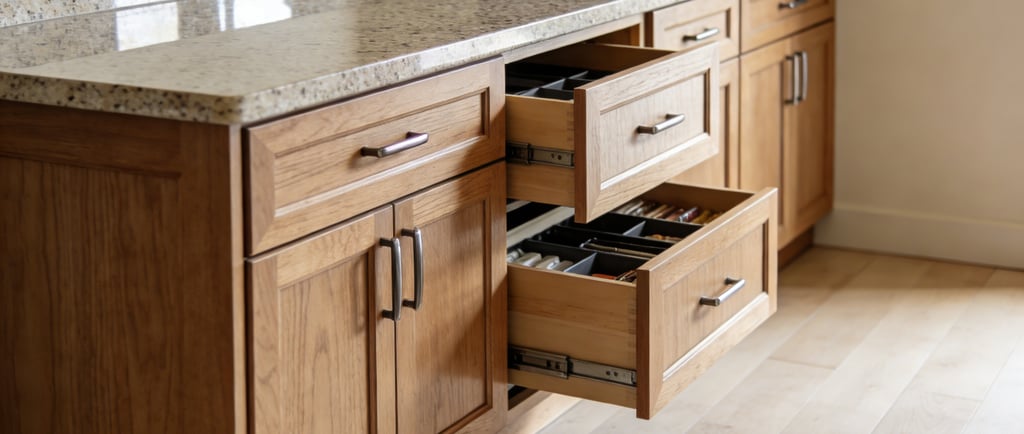
Hey guys! 👋 Are you planning to install custom cabinets at home but feeling overwhelmed by the wide variety of materials, designs, and quotes? Let me tell you, when I renovated my new home, I hit three big pitfalls with just the custom cabinets—chose poor-quality materials that got damp and warped, opted for cheap hardware that loosened in half a year, and got tricked by hidden costs from the merchant. I ended up spending thousands of yuan on rework for no reason!
So today, I’ve compiled a comprehensive guide covering everything from basic pitfalls to detailed checks. Whether you’re installing kitchen, bedroom, or entryway cabinets, beginners can follow these tips to avoid 90% of mistakes and get custom cabinets that balance beauty and functionality. 📌 Stay tuned till the end for a quote trap-avoidance checklist—save it for later!
🔧 1. Define Needs Before Design – Don’t Prioritize Aesthetics Over Functionality
Many people jump straight to worrying about "flat doors or raised panels" or "white or gray," but the core of custom cabinets is never just looks—it’s adapting to your lifestyle! Before consulting a designer, spend a day figuring out these 3 questions to avoid regrets later.
First question: Which space will they go in? Needs vary drastically by space. For kitchen cabinets, frequent cooks must add more drawer cabinets. I used to have too many swing-door cabinets; pots and tableware were piled inside, and I had to rummage for items at the back. Later, I added 3 drawers for categorized storage, which boosted my cooking efficiency. The height of wall cabinets should also fit your height—I’m 165cm tall, and the bottom of the wall cabinets is 72cm above the countertop, so I don’t hit my head while cooking. Taller people can adjust it to 75cm.
Second question: What will you store? Bedroom wardrobes should be divided into men’s and women’s sections. Reserve over 1.6m height for men’s hanging areas to keep suits and coats wrinkle-free. For women, set aside a separate short-clothes section (1.1m) and long-clothes section (1.8m), plus a jewelry drawer with dividers to prevent necklaces and earrings from tangling. Leave a 15cm empty space at the bottom of entryway cabinets for daily shoes—no more bending to open doors. Add an open countertop in the middle for keys and reading glasses, convenient for both the elderly and kids.
Third question: What are your family’s usage habits? For families with kids, opt for rounded corners on wardrobes and bookshelves to avoid collisions. Choose adjustable shelves to raise the height as your child grows. For the elderly, avoid overly high wall cabinets—place frequently used items within easy reach (below 1.2m) to reduce climbing risks.
🪵 2. Choose the Right Material for Each Space – Avoid Pitfalls
Material directly determines the durability and environmental friendliness of custom cabinets. Many merchants pass off cheap particle boards as solid wood or claim E2-grade boards are E0-grade. Let’s learn how to avoid these tricks from three aspects: material characteristics, space adaptation, and identification skills.
✅ Particle Board: The most cost-effective option, priced at around 80-150 RMB/㎡, suitable for dry spaces like bedroom wardrobes and entryway cabinets. Prioritize E0-grade (formaldehyde emission ≤ 0.05mg/m³) or E1-grade (≤ 0.124mg/m³). Insist on a CMA-certified environmental test report from the merchant—verbal promises aren’t enough. Edge banding is also crucial: choose laser or PUR edge banding for thin glue lines and good sealing, which effectively prevents dampness and warping. EVA edge banding is cheaper but has obvious glue lines and may peel off over time.
✅ Multi-layer Solid Wood Board: Highly moisture-resistant, priced at 180-300 RMB/㎡, ideal for kitchens, bathroom dry areas, especially in humid southern regions. Choose 7-layer or 9-layer boards—more layers mean stronger nail-holding capacity, so hinges and pull-out baskets won’t loosen easily. Identification tips: Tap the cabinet—multi-layer solid wood produces a crisp sound, while particle board sounds dull. Check the cross-section: multi-layer wood has a clear layered structure with visible grain.
✅ Solid Wood: The top choice for aesthetics, priced at 300-800 RMB/㎡, perfect for families pursuing texture. Common types include oak, cherry wood, and ash wood. Oak offers great value with high hardness and wear resistance; cherry wood has a warm tone that deepens naturally over time, becoming more beautiful, but it’s more expensive. Note: Solid wood cabinets need moisture-proof treatment—apply moisture-proof paint to the bottom. Keep them away from humid areas like balconies and kitchens. Regular maintenance is required to avoid cracking and warping from direct sunlight.
⚠️ Important Reminder: Don’t be fooled by "zero-formaldehyde boards"! There are no absolutely zero-formaldehyde boards on the market—ones that meet national standards for formaldehyde emissions are safe. Additionally, ask the merchant to specify "board grade, edge banding process, and environmental test report number" in the contract for recourse if discrepancies are found later.
🔩 3. Hardware Is the "Soul" – Don’t Skimp on Details
The lifespan of custom cabinets depends entirely on hardware! My biggest pitfall was choosing cheap hardware—I opted for free no-name hinges from the merchant to save costs, which started squeaking and jamming in half a year. I later replaced all of them with Blum hinges, and they still look brand new after 3 years. So, don’t hesitate to invest in quality hardware.
✨ Core Hardware Brand Recommendations: For hinges, prioritize Blum (Austria), Hettich (Germany), or high-end lines from DTC (China), priced at 60-150 RMB each. Blum’s quick-install hinges are easy to remove and maintain, with uniform damping—suitable for most families. Hettich hinges have higher load-bearing capacity, ideal for thick doors (≥25mm) or glass doors. For drawer slides, choose silent full-extension models from the same brands—more practical than half-extension ones, allowing easy access to items at the back. Opt for slides with a load-bearing capacity of over 30kg; for kitchen drawers, choose over 50kg to safely hold cast-iron pans and rice cookers without sagging.
✨ Hardware Identification & Shopping Tips: Authentic Blum and Hettich hardware have clear laser engravings with neat fonts—counterfeits have blurry engravings. You can also scan the QR code to verify authenticity. Test hinges by opening and closing them 20-30 times—they should feel smooth with consistent damping, no jamming, and no overly fast or slow rebound. Choose hinges with 3D adjustment functions to fine-tune the door’s vertical, horizontal, and depth positions for even gaps after installation.
✨ Don’t Neglect Auxiliary Hardware: Choose handles based on cabinet door width—single-hole handles for doors <40cm, double-hole handles (128mm or 160mm hole spacing) for 40-80cm doors. Concealed handles suit minimalist styles and prevent collisions. For connectors, choose zinc alloy three-in-one connectors—stronger load-bearing than plastic ones, ensuring no looseness or gaps in the cabinet. In the kitchen, add double-layer pull-out baskets or corner baskets to maximize space utilization. Choose stainless steel for scratch resistance and easy cleaning.
📏 4. Accurate Measurement – Don’t Ignore Reserved Space
A single measurement mistake can ruin the entire cabinet installation! My neighbor’s cabinets were 3cm higher than the floor because the tile thickness wasn’t considered during measurement—leaving an ugly, dusty gap that required rework. So, pay close attention to these points during measurement.
① Reserve收口 Space: Walls and floors are rarely perfectly flat. Leave a 5-10mm gap between cabinets and walls/ceilings, which can be filled with caulk or trim later for a neat finish and to accommodate minor wall cracks. If tiles or flooring haven’t been installed yet, reserve 3-5cm for pavement thickness—communicate this with the measurement technician in advance.
② Avoid Obstacles: In the kitchen, work around water pipes, gas pipes, and range hood ducts. Install removable panels around gas pipes for easy maintenance later. In the bedroom, avoid air conditioning vents and sockets—keep cabinets at least 10cm away from sockets to prevent blocking. Use a straightedge to check wall flatness; if the error exceeds 5mm, ask the technician to level the wall before cabinet installation to avoid crooked cabinets.
③ Verify Measurements Precisely: Ask the merchant to conduct two on-site measurements—initial rough measurement and final precise measurement after tiles/flooring are installed. Double-check key dimensions (cabinet height, width, depth) with a tape measure to avoid technician errors. Standard kitchen cabinet depth is 60cm, matching countertop width. Bedroom wardrobes are 55-60cm deep—spacious enough for clothes without taking up too much space.
💰 5. Review Quotes in Detail – Reject Hidden Costs
Custom cabinet quotes are often misleading—many merchants attract customers with low-price packages, then add extra charges later. I was tricked into paying more for "hardware upgrades" and "laser edge banding," so always ask for a detailed breakdown and include every item in the contract.
✅ Confirm Inclusions: Clarify if the total price covers cabinets, doors, hardware (specify brand and model), edge banding, design fees, installation fees, and shipping costs. Check if free on-site measurement and rework are provided to avoid additional charges later.
✅ Beware of Hidden Costs: Common hidden charges include: additional shelves (50-100 RMB each), hardware upgrades (30-80 RMB per piece for switching from no-name to branded), special-shaped cabinets (20%-50% surcharge for corner or curved cabinets), trim strips (20-50 RMB per meter for metal strips), and high-altitude operation fees (100-200 RMB for wall cabinets above 2.5m). Negotiate these prices in advance—either include them in the total or specify surcharges in the contract.
✅ Payment Terms & Warranty: Recommend phased payments—30% deposit (after measurement and design), 50% progress payment (after cabinet installation), and 20% final payment (after full acceptance). Avoid paying the entire amount upfront to retain leverage. For warranties, ensure at least 5 years for cabinets and 5-10 years for hardware. Require the merchant to state "free repair and replacement of damaged parts during the warranty period" in the contract for after-sales protection.
💡 Final Reminder: Supervise the installation on-site if possible. Focus on these checks: cabinet joints should have gaps ≤2mm with no unevenness; hardware should be securely installed—hinge screws tightened, slides smooth and stable; edge banding should be intact with uniform glue lines; cabinet doors should be level with even gaps (2-3mm) and smooth operation. Address issues immediately with the installer to avoid disputes later. If hardware loosens over time, you can adjust it yourself—hinges have three adjustment screws for vertical, horizontal, and depth fine-tuning to realign doors.
SophieShop: Redefining Bespoke Living
As a premier custom cabinetry brand under HomeVipotech HK, SophieShop is a factory-direct custom cabinetry brand in Foshan from China, serving homeowners, contractors, designers, developers, and business partners worldwide.
Products
+86-189-2854-3384
© 2025. All rights reserved.
Contact
info@homevipotech.com
+86-186-8822-6660